Saturday, February 28, 2015

Can Google Continue to Trend Higher?

With shares of Google (NASDAQ:GOOG) trading around $1045, is GOOG an OUTPERFORM, WAIT AND SEE, or STAY AWAY? Let's analyze the stock with the relevant sections of our CHEAT SHEET investing framework:

T = Trends for a Stock’s Movement

Google is a global technology company focused on improving the ways people engage with information. The business is based on the following areas: search, advertising, operating systems and platforms, and enterprise. The company generates revenue primarily by delivering online advertising. Google is a search giant with most of the market share, largely because of its execution and delivery. An increasing number of consumers and companies worldwide are coming online, which will surely increase the amount of eyes on the company's ads and, in turn, advertising revenue. At this rate, look for Google to remain on top of the Internet world.

Google agreed to pay $17 million to 37 states this week for evading cookie-blocking controls in Apple's (NASDAQ:AAPL) Safari browser, but industry experts suggest that the effect the settlement will have on the privacy debate is more significant that than the money penalty itself.

T = Technicals on the Stock Chart Are Strong

Google stock has has been exploding to the upside in the past several years. The stock is currently trading near all-time highs and looks poised to continue. Analyzing the price trend and its strength can be done using key simple moving averages. What are the key moving averages? The 50-day (pink), 100-day (blue), and 200-day (yellow) simple moving averages. As seen in the daily price chart below, Google is trading above its rising key averages, which signal neutral to bullish price action in the near-term.

GOOG

(Source: Thinkorswim)

Taking a look at the implied volatility (red) and implied volatility skew levels of Google options may help determine if investors are bullish, neutral, or bearish.

Implied Volatility (IV)

30-Day IV Percentile

90-Day IV Percentile

Google Options

18.44%

53%

53%

What does this mean? This means that investors or traders are buying a significant amount of call and put options contracts as compared to the last 30 and 90 trading days.

Put IV Skew

Call IV Skew

December Options

Flat

Average

January Options

Flat

Average

As of today, there is an average demand from call buyers or sellers and low demand by put buyers or high demand by put sellers, all neutral to bullish over the next two months. To summarize, investors are buying a significant amount of call and put option contracts and are leaning neutral to bullish over the next two months.

On the next page, let’s take a look at the earnings and revenue growth rates and the conclusion.

E = Earnings Are Increasing Quarter-Over-Quarter

Rising stock prices are often strongly correlated with rising earnings and revenue growth rates. Also, the last four quarterly earnings announcement reactions help gauge investor sentiment on Google’s stock. What do the last four quarterly earnings and revenue growth (Y-O-Y) figures for Google look like and more importantly, how did the markets like these numbers?

2013 Q3

2013 Q2

2013 Q1

2012 Q4

Earnings Growth (Y-O-Y)

21.08%

-5.53%

13.60%

17.06%

Revenue Growth (Y-O-Y)

11.94%

15.52%

31.23%

24.87%

Earnings Reaction

13.79%

-1.55%

4.43%

5.49%

Google has seen increasing earnings and revenue figures over the last four quarters. From these numbers, the markets have had conflicting feelings about Google’s recent earnings announcements.

P = Average Relative Performance Versus Peers and Sector

How has Google stock done relative to its peers, Yahoo (NASDAQ:YHOO), Microsoft (NASDAQ:MSFT), Baidu (NASDAQ:BIDU), and sector?

Google

Yahoo

Microsoft

Baidu

Sector

Year-to-Date Return

47.88%

82.46%

40.98%

56.27%

57.89%

Google has been an average relative performer, year-to-date.

Conclusion

Google is an Internet giant that provides valuable search and advertising services to a growing user base worldwide. The company agreed to pay $17 million to 37 states this week for evading cookie-blocking controls in Apple's Safari browser. The stock has been exploding higher in recent years and is currently trading near all time high prices. Over the last four quarters, earnings and revenues have been increasing. However, investors have had conflicting feelings about recent earnings announcements. Relative to its strong peers and sector, Google has been an average year-to-date performer. Look for Google to OUTPERFORM.

Friday, February 27, 2015

Bill Ackman bets big on Fannie and Freddie

fannie freddie stock

Fannie Mae and Freddie Mac have been hot stocks this year. They just got hotter after Bill Ackman took a stake. Click the chart to track shares of Fannie Mae.

NEW YORK (CNNMoney) Bailed-out mortgage giants Fannie Mae and Freddie Mac are apparently all the rage. Activist investor Bill Ackman disclosed Friday that his firm Pershing Square has taken just under a 10% stake in each of the government-sponsored mortgage giants.

Pershing Square owns more than 115 million common shares of Federal National Mortgage Association (FNMA, Fortune 500) and over 63 million common shares of Federal Home Loan Mortgage (FMCC, Fortune 500) Corp, according to government filings.

The stocks surged on the news and based on where they were trading Friday, his investment in Fannie Mae is worth more than $380 million, while his bet on Freddie Mac is worth about $200 million.

Fannie and Freddie have been overseen by the Federal Housing Finance Agency since their $187 billion bailout in 2008, prompted by massive losses on mortgage securities. They have since returned to profitability, paying substantial dividends to the Treasury Department, and have caught the eye of investors, particularly hedge funds including Bruce Berkowitz's Fairholme Capital.

Both stocks were delisted from the New York Stock Exchange in 2010 and their shares were moved to what's known as the over-the-counter bulletin board, or pink sheets. The two stocks each trade for a little more than $3 apiece. But shares of both companies are up more than 1,000% so far this year, and gained almost 10% Friday on the news of Ackman's stake.

During an interview on CNBC Thursday, Berkowitz, who is also the biggest shareholder of bailed-out insurer AIG (AIG, Fortune 500), said he wants to buy the insurance components of Freddie Mac and Fannie Mae from the government. Berkowitz said "there are no other group of assets that can perform the job necessary for American housing."

"We have the infrastructure. We could have the money. We can make a reasonable return. We don't have to be greedy. We don't need federal support," he added.

Is there a housing bubble in California?   Is there a housing bubble in California?

In the SEC filings, Ackman said the shares of Fannie Mae and Freddie Mac are undervalued and attractive, and he also cited Fairholme's proposal as a reason for his purchase.

Ackman is well-known on Wall Street for investing in companies with the hope! s of convincing management to make big changes. This year, his bet on struggling retailer J.C. Penney (JCP, Fortune 500) flopped. Ackman sold his stake at a loss after CEO Ron Johnson -- who Ackman helped lure from Apple (AAPL, Fortune 500) -- was fired.

Ackman also is sitting on a huge loss on paper with his short against nutritional supplement maker Herbalife (HLF). Shares of Herbalife have more than doubled this year even though Ackman has claimed on numerous occasions that he thinks the company is a pyramid scheme that has no value.

Making matter worse, rival activist investor Carl Icahn has a big stake in Herbalife and has profited handsomely from the stock's rise. The two even exchanged testy words about Herbalife in a CNBC appearance earlier this year.

But Ackman has had one notable win this year. His stake in Procter & Gamble (PG, Fortune 500) has been a winning investment. CEO Bob McDonald resigned earlier this year, a move that was largely attributed to pressure from Ackman. P&G shares are up 25% this year and the stock is at an all-time high. To top of page

Monday, February 16, 2015

Benzinga's Top #PreMarket Gainers

BP plc (NYSE: BP) shares jumped 3.96% to $45.45 in pre-market trading after the company reported upbeat third-quarter profit.

Glu Mobile (NASDAQ: GLUU) surged 2.35% to $3.92 in the pre-market session. Glu Mobile's trailing-twelve-month revenue is $101.46 million.

Yahoo! (NASDAQ: YHOO) shares gained 1.58% to $32.86 in the pre-market session after Bernstein upgraded the stock from Market Perform to Outperform.

Corinthian Colleges (NASDAQ: COCO) soared 1.01% to $2.50 in the pre-market trading. Corinthian's PEG ratio is 1.61.

Posted-In: PreMarket GainersNews Pre-Market Outlook Markets Movers

(c) 2013 Benzinga.com. Benzinga does not provide investment advice. All rights reserved.

  Around the Web, We're Loving... Learn to Use Trading Platforms Like Hedge Fund Traders do Rumsfeld: Denial of Benefits to Fallen Soldiers' Families 'Inexcusable' Come See How the Pro's Trade in this Exclusive Webinar Facebook, Baidu Lead Big Caps Beating Shutdown What Should You Know About AMZN? Most Popular Earnings Expectations For The Week Of October 28: Apple, Facebook, GM and More Apple Down 2% After Q4 Earnings Beat, 33.8 Million iPhones Sold Apple Earnings Preview: Were Nine Million iPhones Enough? (AAPL) CONSOL Energy Executes Agreement to Sell Five West Virginia Longwall Coal Mines and Related Assets for $3.5 Billion of Value; $850M in Cash; $184M in Future Payments Mystery Barge in San Francisco Bay Might Belong To Google UPDATE: Morgan Stanley Upgrades Bristol-Myers Squibb Co. on Potential of New Cancer Drugs Related Articles (COCO + BP) Benzinga's Top #PreMarket Gainers UPDATE: BP Posts Upbeat Q3 Profit, Lifts Dividend Earnings Scheduled For October 29, 2013 Earnings Expectations For The Week Of October 28: Apple, Facebook, GM and More Will China's Pension Crisis Keep the Yuan from Becoming a Global Reserve Currency? Despite Setbacks, Royal Dutch Shell is Not Out of Africa View the discussion thread. Partner Network #marketfy-ae-block { display: none; border: 2px solid #0a3f75; overflow: hidden; width: 300px; height: 125px; text-align: center; background-color: #45719E; position: relative; z-index: 1; } #marketfy-ae-block a { display: block; width: 300px; height: 125px; position: relative; z-index: 2; color: #ffffff; text-decoration: none; } #marketfy-ae-block-countdown-text { color: #f9fc99; padding: 0px 0 0 0; font-size: 19px; font-weight: bold; line-height: 19px; } #marketfy-ae-block-countdown-text-start { font-size: 12px; } #marketfy-ae-block-countdown { padding: 5px 0 5px 0; font-size: 26px; } #marketfy-ae-block-signup { padding: 5px 47px; } #marketfy-ae-block-signup:hover { background-color: #457a1a; } #marketfy-ae-block #marketfy-ae-block-logo { display: block; padding: 3px 0 0 0; margin: 0; } #marketfy-ae-block-logo { text-indent: -9999px; } #marketfy-ae-block-free { display: block; position: absolute; top: 7px; right: -23px; width: 80px; height: 16px; line-height: 16px; text-align: center; opacity: 1; -webkit-transform: rotate(45deg); -moz-transform: rotate(45deg); -ms-transform: rotate(45deg); transform: rotate(45deg); font-size: 13px; font-weight: normal; color: #333333; background-color: yellow; z-index: 500; text-shadow: 1px 1px #999999; } #marketfy-ae-block-arrow { position: relative; width: 60px; height: 60px; z-index: 10; margin: -80px 0 13px -21px; } #marketfy-ae-block-arrow img { height: 60px; width: auto; } Marketfy's International
Traders & Investors Summit Register for this FREE Event! Hosted by Marketfy $(function () { var dateToday = new Date(); var dateCheck = dateToday.getTime() - 60*60*4*1000; var theMarketfyDate = new Date(2013, 8, 21, 9, 00, 00); if(dateCheck

Friday, February 13, 2015

The Better Option: American Capital Agency or Annaly?

It's no secret that mREITs such as American Capital Agency (NASDAQ: AGNC  ) (NASDAQ: AGNC  ) (NASDAQ: AGNC  ) ,  Annaly Capital Management (NYSE: NLY  ) (NYSE: NLY  ) (NYSE: NLY  ) , and CYS Investments have gone through a very turbulent trading period, with all major players losing a sizable share of market value.

Mortgage REITs seem to be moving in an elastic inverse correlation to 10-year Treasury yields, and that's perfectly understandable. These leveraged investments are also reacting strongly to shorter-term developments such as the announcement that CYS CEO Kevin Grant purchased 34,000 shares of stock. This led to spectacular gains for mREITs -- CYS led the rally, shooting up a hefty 7.1%, American Capital rose 4.1%, and Annaly gained 3.2% after this news last month.

Prior to the announcement, CYS stock had lost close to 47% since March, and the gains must have come as welcome news for shareholders. The firm is one of the highest dividend-paying mREITs in the market with a 17.5% dividend yield.

Investors are now wondering which mREIT offers better investment value between the two behemoths of the space: American Capital Agency or Annaly Capital Management. Many mREIT investors not only need high income paying stocks but also those that offer a certain level of protection against loss of capital. To compare them, investors can use the following criteria:

Earnings Interest rates spread Dividends Book value

Earnings
Annaly's second-quarter results looked fairly impressive, comparatively. The firm earned net income of $1.6 billion, equivalent to $1.71 per share. Annaly's second-quarter numbers look even more impressive when you compare them to last year's second-quarter results, when the firm booked a $91 million loss, or $0.10 loss per share.

In sharp contrast, American Capital Agency's second-quarter results looked pretty ugly. The firm booked a nasty overall loss of $936 million, or $2.37 per share.

Interest rates spread
Interest rates fluctuated wildly in the second quarter, thus improving the interest rate spread for many mREITs. The cost of borrowing rose at a slower pace compared to the pace at which yields from investments rose. Annaly reported a 0.98% net interest spread, an improvement over 0.91% in the first quarter. The interest rates spread was, however, considerably lower than last year's second-quarter spread, which came in at 1.54%. The firm's asset yield for its interest-earning portfolio stood at 2.51%. Its average cost of funds shot up seven basis points to 1.53%.

American Capital Agnecy's interest rate spread for the second quarter came in at 1.86%; a marginal drop compared to 1.87% in the first quarter. If we exclude the firm's TBA dollar roll income, the net spread falls to just 1.49%, a slight drop from the first quarter's 1.51%. American Capital Agency's asset yield stood at 2.71% while its average cost of funds shot up 15 basis points to 1.43%.

The average yield on assets rose by a higher absolute amount than the cost to borrow, leading to improved interest rates spread for both mREITs. Although the spread for both firms was OK, American Capital Agency beats Annaly hands-down for a much larger spread. Annaly Capital Management, however, beats American Capital Agency to the tape when we consider interest rate spread growth. Growth in interest rates spread is more important for capital appreciation than larger, but stagnant, absolute spreads. Annaly takes this category.

Dividends
Annaly reported a $0.40 dividend per share for the quarter, a 2.25% sequential drop. The dividend is also considerably lower than 2012's second-quarter dividend of $0.55. Although Annaly's dividend for the quarter was quite low, it was well within the firm's estimated taxable income per share of $0.47. This means the firm had sufficient cash to pay out the dividend. At a share price of $11.50, the dividend is equivalent to an annualized yield of a respectable 14%.

American Capital Agency reported a second-quarter dividend of $1.05 per share, down 16% sequentially. Although the firm's dividend fell considerably, it still beat consensus estimates of about $1.00 per share. The $1.05 payment is less than the firm's dollar roll income and net spread of $1.15 per share. American Capital Agency, therefore, had sufficient cash to pay out the dividend. The dividend yield works out to be around 18.4%, based on today's price. This helps to buttress the firm's solid reputation as an all-weather mREIT dividend play.

Interest rates seem to have stabilized, and it is quite likely that dividends for both firms will remain around these levels for the rest of the year. Although American Capital Agency takes the cake for higher absolute dividend yield of 18.4% compared to Annaly's 14%, its dividend deterioration is outpacing Annaly's at 16% vs. 11%. If the deterioration in dividends continues at these rates, American Capital Agency's payout will eventually be lower than Annaly's.

Book value
Annaly's stock is currently trading 12% below the most recently reported book value. American Capital Agency is trading at 11% below book.

The volatility of mortgage-backed securities prices has led to both stocks declining considerably in the third quarter. In the previous quarter, Annaly's book valued declined roughly 18% while American Capital Agency experienced a nearly 20% decline. Annaly and its slightly more conservative strategy, therefore, lost slightly less book value and is the winner in this category.

The better value for investors
American Capital Agency reported far worse earnings in the second quarter than Annaly. Although the firm has a larger interest rate spread in absolute terms, its spread remains stagnant while Annaly's is expanding. Book values for both companies remain well above current stock prices. American Capital Agency pays a higher dividend than Annaly, but its dividend is falling at a faster pace.

At this point, Annaly may be the mREIT that offers the better value for investors. 

Dividend stocks, like well-managed REITs, can make you rich. It's as simple as that. While they don't garner the notoriety of high-flying growth stocks, they're also less likely to crash and burn. And over the long term, the compounding effect of the quarterly payouts, as well as their growth, adds up faster than most investors imagine. With this in mind, our analysts sat down to identify the absolute best of the best when it comes to rock-solid dividend stocks, drawing up a list in this free report of nine that fit the bill. To discover the identities of these companies before the rest of the market catches on, you can download this valuable free report by simply clicking here now.

3D Printing Firm Stratasys Registers Shares for Sale

Stratasys Ltd. (NASDAQ: SSYS) has filed a shelf registration statement with the U.S. Securities and Exchange Commission to allow it to issue sell an unspecified number of ordinary shares, warrants, and debt securities. At the same time the firm filed a Form 424 registering 6.93 million shares for sale at a maximum aggregate price of $768 million. The maximum per share price is given as $110.85.

About 3.92 million of the registered shares are were issued by Stratasys to and are now owned by shareholders of MakerBot, a maker of desktop 3D printers that Stratasys acquired in June for $400 million. The remaining 3.01 million shares included in this registration statement are intended to pay for potential further earnouts and payments to MakerBot stakeholders. Stratasys will receive no proceeds from the stakeholders' sale of these shares.

Since The ExOne Co. (NASDAQ: XONE)) came public in February, shares of Stratasys have risen about 37% compared with a rise of about 47% in the shares of peer 3D Systems Inc. (NYSE: DDD). The big gainer has been ExOne, up about 160% since coming public.

Stratasys has already completed one significant merger, with 3D-printer maker Objet, and the MakerBot acquisition gives the firm a product that could attract consumers as well as commercial buyers. 3D Systems offers a personal 3D printer for around $1,300, significantly less than the $2,200 price tag on the MakerBot device. ExOne has no entry in the low-end space.

Shares of Stratasys are trading at $109.73, up 2.4%, late Tuesday afternoon. The 52-week range is $53.53 to $113.49.

Wednesday, February 11, 2015

Honoring Advisors Who Serve(d): July 4th, 2013

On Memorial Day, the nation paused to remember those who, in the words of Abraham Lincoln, gave “the last full measure of devotion.” AdvisorOne honored those advisors and partners to advisors—and one famous non-advisor who influences the advisory world, PIMCO’s Bill Gross—who served in the armed forces of the United States.

This is the third year we’ve published this slideshow that is meant, in a small way, to thank all those who served their country. For this Fourth of July edition we’re featuring seven “new” advisors and four from previous Advisors Who Serve(d) slideshows.

We’ve created a special landing page for you to view our previous slideshows as well. The seven new people on the following pages responded to our call this year to share the particulars of their service—some in the past and some still serving—and, in most instances, some photos of themselves when they were in service. 

Most telling to us, however, were the vets’ responses to how their military service helped prepared them for their advisory careers. We began this series of slideshows in 2011 because anecdotally there seemed to be a large percentage of advisors, both men and women, who had served in one of the branches of the military over the years but in many cases had not received the appreciation they were due for their service.

The comments of this group on their military experiences speak for themselves—profound and humorous, patriotic and often self-deprecating, but humbly proud of their service as well.

(Check out previous Advisors Who Serve(d) installments from 2011 and 2012 for Memorial Day and Fourth of July.)

John Grover WilsonName: John Grover Wilson

Title/Company: Managing Director, Senior Investment Advisor — Raymond James & Associates

Branch: USAF-retired

Rank held at beginning of service and at end: Lt. at beginning, Col. at the end

Service Dates: 1968-1992

Work you did: Fighter Pilot, F-4, RF-4 and others

Brief story that stands out from your service time: Hold the Air Medal (2) and Distinguished Flying Cross from serving in Vietnam. I’m presently the Chief Chaplain of the Volunteer State Veterans Honor Guard. In my spare time, I presided over 250 military funerals with honor. I am presently on the steering committee for the Medal of Honor Society Conference in 2014 to be held in Knoxville. Flew two tours in SEA. Funny story: I was a White House Social Aide during the Nixon administration.

David S. ChangName: David S. Chang

Title/Company: President, CEO — WealthBridge

Branch: Army

Rank held at beginning of service and at end: Cadet; Major

Service Dates: 1998-2008 (Active duty) 2009 to Present (Hawaii Army National Guard)

Work you did: West Point Cadet, Armor Officer, Ground Scout Platoon Leader, Military Intelligence Officer

Brief story that stands out from your service time: I spent 15 months in Northern Iraq. The work hours were grueling but what made life bearable were the soldiers I served with, we were all one big happy family. I knew that my XO (executive officer) went to high school with Rachael Ray. He knew I was a big fan of hers, especially since I am an eater! During Christmas my XO brought me up to the front of our commanders and staff after a normal meeting and surprised me with an autographed photo of Rachael Ray made out to me! It was one of the best Christmas gifts I got, I am very appreciative that he took the time to reach out to her and she in turn took time to write to me. It was a definite morale booster!

John Thomas DeutschName: John Thomas Deutsch

Title/Company: Senior VP, Investments — Raymond James & Associates

Branch: U.S. Navy

Rank held at beginning of service and at end: Seaman to CWO(4)

Service Dates: 1962-1985

Work you did: Avionics Commissioned Warrant Officer W-4

Brief story that stands out from your service time: Too many great shipmates and funny stories for one to stand out but, late in my career, I served on the USS Coral Sea CV-43. Our Battle Group as well as the Nimitz’s were stationed in the Indian Ocean in support of the Iranian hostages rescue attempt on Aug. 24, 1980. Tragically, the operation was unsuccessful and ended with the loss of aircraft and eight US service members. Memorably, I was walking on the flight deck with support attack aircraft fully loaded out after midnight when our Captain, Dick Dunleavy, announced on the 1MC that we would be standing down because of the failed outcome. That was one of the first publicized uses of special forces to effect U.S. policy objectives. Today, 30 years hence, both Iran and heroic special forces operators remain in our daily headlines and in my memory.

Kevin HottName: Kevin Hott

Title/Company: Financial Advisor — Merrill Lynch

Branch: U.S. Navy

Rank held at beginning of service and at end: E1-E4/Seaman Recruit to Petty Officer Third Class

Service Dates: 1997-2001

Work you did: Gas Turbine Systems Electrician

Brief story that stands out from your service time: The first morning after arriving at Recruit Training Center Great Lakes I found myself being awoken abruptly by the Drill Instructor. He was screaming in my face, nose-to-nose, after I overslept by a “few minutes.” I learned quickly when you’re the only one not in formation you get the wrong kind of attention. While we were deployed in the Mediterranean, I remember the roller coaster of emotions we experienced when we all learned of the USS Cole bombing. Oh, and how can I forget the swim call we had in the middle of the Mediterranean? When you have folks jumping off the side of a destroyer into 13,000 feet of water it’s not a pleasant experience when you’re in the water and realize the ship isn’t completely stopped.  David LatchName: David Latch

Title/Company: President — Frederick Advisors

Branch: U.S. Army

Rank held at beginning of service and at end:  E-3, O-4

Service Dates: 1977-1999

Work you did: Aircraft Maintenance, then Medical Logistics

Brief story that stands out from your service time: I was nearing the end of my first enlistment and was unsure about re-enlisting. My NCIOC, whom I really didn’t think much of, told me to write down the pros and cons of both staying in and getting out. Once I did that, I became a “lifer.”

James SchwartzName: James Schwartz

Title/Company: Senior Advisor — Strategic Wealth Advisors

Branch: U.S. Air Force

Rank held at beginning of service and at end: 2nd Lt to Captain

Service Dates: 1985-1997

Work you did: A-10 and F-16 Fighter Pilot

Brief story that stands out from your service time: The first year in the USAF was spent in pilot training near Del Rio, Texas. While learning to fly the T-37, student pilots must become proficient in acrobatics, including loops, barrel rolls and split-S's. The split-S is a maneuver where the pilot rolls the jet upside down then pulls back on the stick forcing the jet to fly straight down then continue to a level flight path heading the opposite direction (think of the second half of a loop). As I went through my split-S maneuver and the nose of the aircraft was going straight down toward the earth, my instructor, sitting to my right, said, “Jim, you better pull a little harder.”

And so I did—probably a little too quickly and a little too hard. The G's (acceleration one feels on their body at the bottom of a roller coaster) increased from zero to 3, then 4, and finally 5. At 5 G's a 150-pound person weighs 750 pounds! Well, my instructor wasn’t prepared for such a quick transition to 5 G's and he passed out! I finished my split-S back to level flight but it took my instructor some time to regain consciousness and figure out where he was (later he divulged to me that when he came to he thought we had crashed). At this point the flight was over (due to the loss of consciousness episode) and I flew him back to the base where after two days he was back in the saddle. As I look back at that incident, as a new student pilot, I have to say I was a little scared when I realized my instructor (the person I counted on to be there when I screwed up) had lost consciousness and it was up to me to bring him home. Robert Peterson with co-worker Barb EmenhiserName: Robert S. Peterson

Title/Company: Vice President, Investments — Raymond James & Associates

Branch: U.S. Army

Rank held at beginning of service and at end: Pvt. to Sergeant

Service Dates: 1970-1973

Work you did: Military Intelligence, Linguist

Brief story that stands out from your service time: I was trained as an interrogator and a linguist in Laotian. I spent most of my time teaching English to foreign nationals.

Bill Gross (left) standing tall in the bridge.Name: Bill Gross

Title/Company: PIMCO - founder and co-chief investment officer

Branch: U.S. Navy

Rank held at beginning of service and at end: LT JG – Lieutenant, Junior Grade

Service Dates:  1967 - 1970

Work you did: N/A

Brief story that stands out from your service time: I arrived at the Pensacola Naval Air Station ready to fulfill my enlistment and ready to become a fighter pilot. And like all raw recruits, we were put in the capable hands of a drill sergeant. Remember, the drill sergeant’s duty is to humiliate and harass us to the breaking point and beyond. And me, the cocky college boy, was so shaken by the experience that it was one of the military moments I remember most vividly. I spent half the night cleaning my rifle, and failing the inspections nonetheless. It took me so long to make up my bunk to my sergeant’s specifications that I slept on the floor. I did push-ups and chin-ups and marched and ran obstacle courses but my sergeant was never satisfied. “You’ll never fly a jet Mr. Gross!,” he screamed. “BLIMPS are more your style!” I ended up flying neither.

Meredith Schneider in Bosnia

Meredith Schneider

Title/Company: Principal — Schneider Wealth Management

Branch/Rank: US Army - 2nd Lt through Captain

Service Dates: June ’92 - Aug. ’96

Work you did: Platoon Leader, Maintenance Officer, S-1, Civil Affairs Officer

Brief story that stands out from your service time: I am honored to have had the opportunity to meet so many people from all over the country who served with great dedication. I will never forget the "Any Solider" letters we received while in Bosnia. Some days they were the only link to life outside of our tents since we had no phone, television, newspaper, Internet, and often no mail from loved ones. I remember a letter in particular from a young boy in Rhode Island who wrote in reply to a letter I wrote back to him. He wrote, "Receiving your letter was the happiest day of my life." Little did he know how happy I was to receive his letter of support.

Harold Evensky

Harold Evensky

One of the few people in the advisor community who is identified by one name, like a Brazilian soccer player, Evensky is the chairman and cofounder of the wealth management firm of Evensky & Katz in Coral Gables, Fla. He is the author of numerous books, is now an adjunct professor at Texas Tech University and among his honors has been membership of the IA25. But Harold is also a veteran, serving in the Medical Corps of the U.S. Army as a Captain from 1968-1971.

Joni Youngwirth

Joni Youngwirth

Folks from Commonwealth Financial Network know Youngwirth quite well, as do other advisors who have benefited from her practice management knowledge delivered in speeches at national conferences, or who have read some of her prescriptions in the pages of Investment Advisor, for instance. 

They may know of her practical, disciplined bent when it comes to practice management, but what they may not know is that this partner to advisors previously served with the U.S. Air Force, rising to the rank of first lieutenant.

Youngwirth is Commonwealth Financial Network's managing principal, practice management, and a regular contributor to Investment Advisor.

-----

Check out previous Advisors Who Serve(d) installments from 2011 and 2012 for Memorial Day and Fourth of July.

We know there are more of you out there who served, so please consider adding your name and story to the growing list of Advisors Who Serve(d) by filling out this simple questionnaire at AdvisorOne.

Tuesday, February 10, 2015

It's Microsoft's Turn to Cut Surface Prices

'Tis the season for tablet price cuts. First, Barnes & Noble made its Nook discounts permanent ahead of surrendering in the tablet market altogether. Next, Amazon.com followed suit with its recent round of Kindle Fire price cuts to fend off the Nook and pave the way for new models. Now, Microsoft (NASDAQ: MSFT  ) is about to drop the price of its Surface RT devices.

The Verge's well-placed tipsters say that the software giant is reducing the price of each model by $150, which will bring the entry-level 32 GB model down to $350 and the 64 GB model to $450. Adding a Touch Cover will tack on $100 to the price tag. Like its rivals, Microsoft is likely preparing to launch a new generation of Surface devices, so the discount will help spur sales and clear out inventory.

In March, Bloomberg had reported that Microsoft had sold 1.5 million Surface units since the October launch, which was shy of expectations. Of these, 400,000 were Surface Pro tablets, which launched in February. IDC estimated that Microsoft shipped 900,000 in each of the fourth and first quarters, totaling 1.8 million in channel shipments. The company has also been hoping for Surface to gain traction in the education market, offering the device for as little as $199.

At $350, Surface RT will be the most affordable large-sized tablet among the major tech players. Google sells the Samsung-built Nexus 10 for $400, but Big G has resisted cutting the price of the Nexus 7 even with new models imminent. Apple has always stood pat at $500 for its flagship iPad with Retina display. Samsung's new Galaxy Tab 3 10.1 is also priced at $400.

Microsoft is putting a whole lot of weight behind its future as a devices-and-services company. To that end, it will be interesting to see whether or not the company discontinues the first-generation model once Surface RT 2 launches, moving them down to lower price points to expand the product lineup, or if it discontinues it. Both Amazon and Apple use the strategy of offering older models at lower prices.

Perhaps the company is retreating from the $500 price point altogether, as no tablet rival has challenged Apple directly at $500 thus far with even remote success. Pricing Surface RT at $400 or lower in the long term is a much better bet.

It's incredible to think just how much of our digital and technological lives are almost entirely shaped and molded by just a handful of companies like Apple and Microsoft. Find out "Who Will Win the War Between the 5 Biggest Tech Stocks?" in The Motley Fool's latest free report, which details the knock-down, drag-out battle being waged by the five kings of tech. Click here to keep reading.

Monday, February 9, 2015

Celgene Adds $3 Billion to Buyback Program

Having already purchased $1.8 billion worth of stock so far this year and having exhausted its existing $2.5 billion share repurchase program, biopharmaceutical Celgene (NASDAQ: CELG  ) announced this morning that its board of directors has authorized a new $3 billion buyback program.

Celgene said the purchases may be made in the open market or through privately negotiated transactions. Over the last four years, the biopharmaceutical has bought back approximately $6.5 billion of its stock.

Headquartered in Summit, N.J., Celgene is engaged in the discovery, development, and commercialization of novel therapies for the treatment of cancer and inflammatory diseases through gene and protein regulation. It generated $5.7 billion in revenues over the last 12-month period ending March 31.

CELG Stock Buybacks Chart

CELG Stock Buybacks data by YCharts.

Sunday, February 8, 2015

2 Biotech Stocks in Activist Investors' Crosshairs

Activist investors are no stranger to the health-care sector, an industry known for binary events and buyouts. In this video, health-care analyst David Williamson discusses two recent news items catching the attention of investors following the moves of these heavyweight activists.

The first is Forest Labs CEO Howard Solomon's announcement he will call it a career as the head of the company. Legendary investor Carl Icahn, who is a major Forest shareholder and has a board seat, has shown misgivings in the past toward management. He has no comment on this news, but he may use the opportunity to exert his influence on Forest's direction.

Obesity-drug maker VIVUS has found itself in the activist investor crosshairs as well. First Manhattan, which controls 9.9% of the company, has been critical of its unpartnered launch of Qsymia and has recruited Icahn disciple Alex Denner, nominating him for the board of directors along with eight others. If successful on July 15, expect First Manhattan to try to shake up VIVUS by aggressively pursuing a partnership or possibly even a sale.

Who will win the obesity-drug market?
Can VIVUS pick up its lagging sales and fend off the competition, or will Arena Pharmaceuticals reign supreme in the obesity space? If you're in the dark, grab copies of The Motley Fool's premium research reports on VIVUS and Arena Pharmaceuticals to stay up to date. Senior biotech analyst Brian Orelli gives investors the must-know information, including an in-depth look at the obesity market and reasons to buy and sell both stocks. Click now for an exclusive look at Arena and VIVUS -- complete with a full year of free updates -- today.

Follow David on Twitter: @MotleyDavid.

Saturday, February 7, 2015

Symmetricom Names New CEO

San Jose, Calif.-based Symmetricom (NASDAQ: SYMM  ) has a new chief executive officer.

On Tuesday, the "precise time" computer announced a series of changes in upper management. Current CEO David G. Cote is leaving the company "to pursue other interests" and has been replaced by new CEO Elizabeth A. Fetter, a current board member. Details on Fetter's compensation have yet to be filed with the SEC.

Additionally, Chairman of the Board Robert T. Clarkson is ceding his chair to new Chairman James Chiddix (although Clarkson will remain on the board, and actually chair the compensation committee). Finally, board members Alfred F. Boschulte and Richard W. Oliver plan to retire from the board when their terms of office expire in October.

Symmetricom shares, which have lagged the broader stock market significantly over the past year and under the past management, responded positively to the change in tack, rising 2.4% in Tuesday trading to closer at $5.20. 

Friday, February 6, 2015

Bernard Horn Comments on CarterĂ¢€™s Inc

In consumer discretionary, Carter's Inc. (CRI) had double digit gains after posting strong second quarter results and raising its 2014 guidance. The company is benefitting from falling cotton prices due to bumper U.S. harvests and increased demand for apparel, resulting in healthy same store sales and new store openings.From Bernard Horn (Trades, Portfolio)'s Polaris Global Value Fund Q3 2014 Shareholder Letter.Also check out: Bernard Horn Undervalued Stocks Bernard Horn Top Growth Companies Bernard Horn High Yield stocks, and Stocks that Bernard Horn keeps buying

Currently 0.00/512345

Rating: 0.0/5 (0 votes)

Email FeedsSubscribe via Email RSS FeedsSubscribe RSS Comments Please leave your comment:
More GuruFocus Links
Latest Guru Picks Value Strategies
Warren Buffett Portfolio Ben Graham Net-Net
Real Time Picks Buffett-Munger Screener
Aggregated Portfolio Undervalued Predictable
ETFs, Options Low P/S Companies
Insider Trends 10-Year Financials
52-Week Lows Interactive Charts
Model Portfolios DCF Calculator
RSS Feed Monthly Newsletters
The All-In-One Screener Portfolio Tracking Tool
iPhone App MORE GURUFOCUS LINKS
Latest Guru Picks Value Strategies
Warren Buffett Portfolio Ben Graham Net-Net
Real Time Picks Buffett-Munger Screener
Aggregated Portfolio Undervalued Predictable
ETFs, Options Low P/S Companies
Insider Trends 10-Year Financials
52-Week Lows Interactive Charts
Model Portfolios DCF Calculator
RSS Feed Monthly Newsletters
The All-In-One Screener Portfolio Tracking Tool
CRI STOCK PRICE CHART 78.89 (1y: +14%) $(function(){var seriesOptions=[],yAxisOptions=[],name='CRI',display='';Highcharts.setOptions({global:{useUTC:true}});var d=new Date();$current_day=d.getDay();if($current_day==5||$current_day==0||$current_day==6){day=4;}else{day=7;} seriesOptions[0]={id:name,animation:false,color:'#4572A7',lineWidth:1,name:name.toUpperCase()+' stock price',threshold:null,data:[[1383195600000,69.15],[1383282000000,69.98],[1383544800000,70.47],[1383631200000,70.06],[1383717600000,69.45],[1383804000000,68.27],[1383890400000,68.77],[1384149600000,69.64],[1384236000000,69.42],[1384322400000,70.05],[1384408800000,70.2],[1384495200000,70.18],[1384754400000,69.84],[1384840800000,69.91],[1384927200000,69.96],[1385013600000,70.36],[1385100000000,70.22],[1385359200000,70.69],[1385445600000,70.62],[1385532000000,70.86],[1385704800000,70.67],[1385964000000,70.07],[1386050400000,69.89],[1386136800000,70.46],[1386223200000,70.45],[1386309600000,70.25],[1386568800000,70.33],[1386655200000,69.96],[1386741600000,69.75],[1386828000000,69.68],[1386914400000,69.69],[1387173600000,70.05],[1387260000000,70.3],[1387346400000,70.71],[1387432800000,70.32],[1387519200000,70.36],[1387778400000,71.03],[1387864800000,71.03],[1388037600000,71.13],[1388124000000,71.07],[1388383200000,71.93],[1388469600000,71.79],[1388642400000,72.34],[1388728800000,72.37],[1388988000000,72.52],[1389074400000,72.65],[1389160800000,72.63],[1389247200000,72.77],[1389333600000,72.91],[1389592800000,71.65],[1389679200000,71.63],[1389765600000,71.48],[1389852000000,70.83],[1389938400000,70.3],[1390284000000,70.07],[1390370400000,69.73],[1390456800000,69.7],[1390543200000,69.16],[1390802400000,68.44],[1390888800000,67.85],[1390975200000,66.82],[1391061600000,67.72],[1391148000000,67.25],[1391407200000,65.5],[1391493600000,65.51],[1391580000000,64.84],[1391666400000,65.34],[1391752800000,66.67],[1392012000000,66.4],
Wednesday, February 4, 2015

Cliffs Natural Resources: Deutsche Bank Cuts EPS Estimates in Half on Lower Iron Prices

The analysts keep piling on Cliffs Natural Resources (CLF), with Deutsche Bank the latest to predict tougher times ahead for the iron miner. The reason: lower iron prices.

Deutsche Bank’s Jorge Beristainand team explain:

DB's commodities team has cut its 2014-16E seaborne iron ore prices by an average of ~$10/t (-9%) to average ~$97/t during time period ($5/t higher-than-current spot). New iron ore price forecasts reflect recent spot price movement (-33% YTD) and considers a scenario of lower Chinese demand…

We are lowering our 2014-16E EBITDA estimates for Cliffs by 11-29% and EPS by 46-84%, on reductions of 3-8% in iron ore price realizations (as US legacy iron ore operations somewhat buffer impact of reduced seaborne prices). EPS estimates cut to $0.50 (-46% vs prior) in 2014, $0.24 (-63%) in 2015 and $0.26 (-84%) in 2016, which are fairly in-line with ThomsonOne consensus estimates of $0.13, $0.23 and $0.21, respectively, albeit an increasingly meaningless number as EPS are now trending towards pennies per share vs +$11/share as recently as 2011.

And yes, Beristain says Cliffs dividend could be at risk.”…our estimates assume that dividends to common shareholders cease to be paid starting in 1Q15 (preferred dividends continue to be paid) in effort to conserve cash,” he says.

Today, at least, the report doesn’t seem to be having an impact. Shares of Cliffs Natural Resources have gained 2.3% to $14.07 today.

Tuesday, February 3, 2015

3 Hot Stocks Everyone Is Talking About

BALTIMORE (Stockpickr) -- Put down the 10-K filings and the stock screeners. It's time to take a break from the traditional methods of generating investment ideas. Instead, let the crowd do it for you.

>>Must-See Charts: Fight the Selling With These 5 Trades

From hedge funds to individual investors, scores of market participants are turning to social media to figure out which stocks are worth watching. It's a concept that's known as "crowdsourcing," and it uses the masses to identify emerging trends in the market.

Crowdsourcing has long been a popular tool for the advertising industry, but it also makes a lot of sense as an investment tool. After all, the market is completely driven by the supply and demand, so it can be valuable to see what names are trending among the crowd.

While some fund managers are already trying to leverage social media resources like Twitter to find algorithmic trading opportunities, for most investors, crowdsourcing works best as a starting point for investors who want a starting point in their analysis. Today, we'll leverage the power of the crowd to take a look at some of the most active stocks on the market today.

>>5 Short-Squeeze Stocks Poised to Pop

These "most active" names are the most heavily-traded names on the market -- and often, uber-active names have some sort of a technical or fundamental catalyst driving investors' attention on shares. And when there's a big catalyst, there's often a trading opportunity.

Without further ado, here's a look at today's stocks.

Whole Foods Market


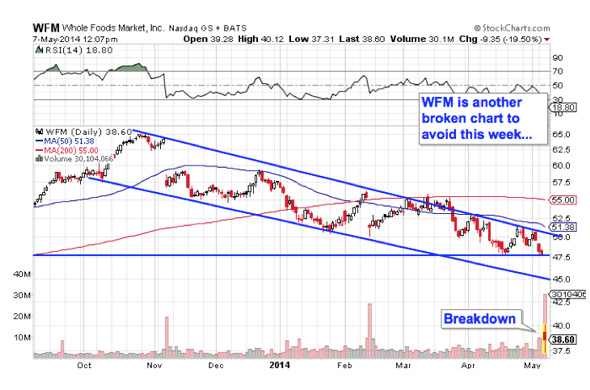
Nearest Resistance: $47.50

Nearest Support: N/A

Catalyst: Q2 Earnings

Whole Foods Market (WFM) is getting utterly shellacked this afternoon, down more than 19% following the firm's second quarter earnings call. WFM reported earnings of 38 cents per share on record sales for the quarter, but the profit measure came in shy of the 41 cents that analysts were expecting. Worse, Whole Foods lowered its guidance for the rest of 2014, committing the ultimate sin as far as investors are concerned.

Technically speaking, this chart is broken -- not that it looked all that attractive before today. Shares have been in a downtrend since October, but today's huge selling is pushing the upscale grocer down through support at $47.50 and clearing the way for further downside. Caveat emptor.

Mondelez International


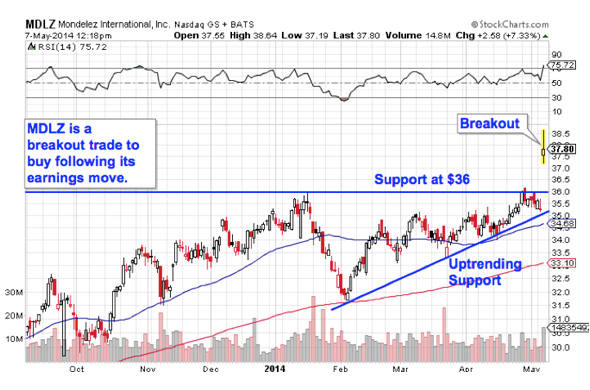
Nearest Resistance: N/A

Nearest Support: $36

Catalyst: Q1 Earnings, Restructuring

Mondelez International (MDLZ) is one of the few names that's rallying hard this afternoon, in this case on the heels of a strong first-quarter earnings call. The firm earned 9 cents in the first quarter, a number that fell well short of the 34-cent average estimate that analysts were looking for. But news that the firm was pursuing a $3.5 billion corporate restructuring program is breaking shares out to new highs. The program is expected to save $1.5 billion in the next four years.

New highs are significant from an investor psychology standpoint because they mean that everyone who has bought shares in the last year is sitting on gains. As a result, the "back to even" mentality is less of a concern than it would be for a name with a higher proportion of shareholders sitting on losses. If you decide to be a buyer here, it makes sense to keep a tight protective stop in place.

Amazon.com


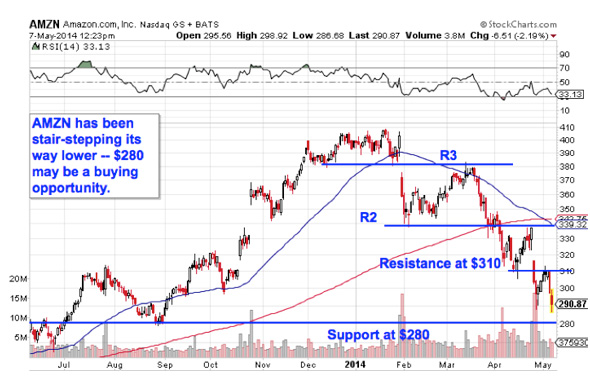
Nearest Resistance: $310

Nearest Support: $280

Catalyst: Technical Setup

Ecommerce behemoth Amazon.com (AMZN) is off by more than 2% this afternoon, just the latest move lower in a series of selloffs that started following the firm's fourth quarter earnings release back in January. Suddenly, investors weren't as content to let Amazon keep on operating without a profit -- and the selling hasn't stopped in the four months that have followed.

But $280 could be the end of it -- that level has been a key support zone since last August. Wait for a bounce off of that level before trying to snatch up shares on the cheap; $280 is a stronger floor for shares than the ones that have preceded it, but it could still get violated. Waiting for the bounce keeps you out of AMZN until buyers have already stepped up to the plate.

To see these stocks in action, check out the at Most-Active Stocks portfolio on Stockpickr.


-- Written by Jonas Elmerraji in Baltimore.


RELATED LINKS:


>>5 Stocks Insiders Love Right Now


>>4 Stocks Rising on Big Volume


>>3 Stocks Under $10 Making Big Moves

Follow Stockpickr on Twitter and become a fan on Facebook.

At the time of publication, author had no positions in the names mentioned.

Jonas Elmerraji, CMT, is a senior market analyst at Agora Financial in Baltimore and a contributor to

TheStreet. Before that, he managed a portfolio of stocks for an investment advisory returned 15% in 2008. He has been featured in Forbes , Investor's Business Daily, and on CNBC.com. Jonas holds a degree in financial economics from UMBC and the Chartered Market Technician designation.

Follow Jonas on Twitter @JonasElmerraji


Fruit of the Loom: Naked Cowboy in new undies

NEW YORK (AP) — It's a natural fit. Fruit of the Loom is launching its new boxer briefs for men with the help of Times Square favorite the Naked Cowboy.

The New York City fixture — real name Robert Burck — who reached fame by strumming his guitar clad in only his underwear, cowboy boots and a cowboy hat, will help launch the new line with promotions beginning Tuesday.

While he usually wears traditional white briefs, the marketing campaign will see him switch to Fruit of the Loom's new underwear, which have tapered legs to prevent them from riding up. Also on Tuesday, samples and coupons will be given out in Times Square from 8 a.m. to 2 p.m. ET.

Melissa Burgess-Taylor, senior vice president for marketing and merchandising for Fruit of the Loom, said the campaign was a chance to work with a New York icon.

"His primary wardrobe is so important to his daily job, we thought why not showcase him in our new boxer briefs," she said.

An accompanying billboard on the Nasdaq Tower in Times Square will read, "Even the Naked Cowboy has changed his underwear."

The company wouldn't disclose what it is spending on the campaign. A separate TV campaign shows men and women performing jobs like orchestra conductor and baseball grounds crew performing in their underwear.

The briefs will be sold in several colors in Walmart, Kmart and Target stores for $13.99 for a five-pack beginning this month.

Monday, February 2, 2015

Winners and Losers: A Go for Amazon, Cheeri-Oops

Earns General Mills Paul Sakuma/AP From a cereal giant infuriating its fans to the leading online retailer boosting the pedigree of its catalog, here's a rundown of the week's smartest moves and biggest blunders in the business world. Apple (AAPL) -- Winner It's been a while since Apple produced blowout quarterly results, but that's what happened on Wednesday. The consumer tech giant moved higher after posting better than expected earnings, margins and iPhone sales. The report wasn't perfect. Bulls will point to the 17 percent spike in iPhone units sales, but bears can counter that Apple sold 16 percent fewer iPads than it did a year earlier. However, when you tack on Apple's declaration of a stock split and a beefed-up share buyback, it was clearly a quarter for the bulls. General Mills (GIS) -- Loser Sometimes it doesn't pay to update a company's privacy policy. Cereal giant General Mills came under fire earlier this month after introducing new legal terms. The updated policy going out to anyone interacting with General Mills online would "require all disputes related to the purchase or use of any General Mills product or service to be resolved through binding arbitration." It got called out in a New York Times article, suggesting that anyone doing something as simple as using an online coupon or liking the company's Cheerios page on Facebook would not be able to sue the company. General Mills argued that the policy was being misread and misunderstood, but it reversed the language. Judging by the comments on that Cheerios page, it seems that some irate consumers aren't so quick to forgive General Mills. Amazon.com (AMZN) -- Winner One of the knocks on Amazon's new Fire TV set-top media player is that it doesn't stream HBO Go content, but Amazon and HBO parent Time Warner (TWX) have agreed to remedy the situation later this year. However, the bigger deal between Time Warner and Amazon is that HBO will be making many older shows and earlier seasons of some current shows available on Amazon's Prime Instant Video platform. Come May 21, folks paying $99 a year for Amazon Prime -- which includes complimentary two-day shipping and monthly Kindle e-book rentals -- will be able to stream the entire runs of "The Sopranos," "Six Feet Under" and more. Some current shows -- including "Boardwalk Empire" and "True Blood" -- will be available for seasons that are at least three years old. It's a major win for Amazon at a time when it's getting hard to differentiate its streaming service from Netflix. McDonald's (MCD) -- Loser There hasn't been a McFlurry of activity at the neighborhood McDonald's these days. The leading burger flipper posted yet another disappointing quarter this week. U.S. comparable-restaurant sales declined 1.7 percent, making this the third consecutive period of negative comps. It conceded that there's no "silver bullet" to turn things around for the Golden Arches. It raised prices by an average of 3 percent toward the end of the quarter, but if it's having a hard time drawing customers now, it's hard to imagine passing on escalating foods costs can pay off in the near future. Hasbro (HAS) -- Winner Toy companies haven't been shining bright these days as kids find digital diversions away from traditional playthings. However, Hasbro still came through with a better than expected performance in its latest quarter on the strength of its toys for girls. Hasbro saw sales for its girls category soar 21 percent during the quarter. The continuing success of My Little Pony played a major part, but the same can also be said about Nerf Rebelle. The Nerf blasters with crossbow attachments were introduced late last year, and apparently they are selling briskly. The Hollywood success of "Brave" and "Hunger Games," with crossbow-packing heroine,s likely played a starring role in boosting interest for Hasbro's soft-dart launchers for girls. Nice aim, Hasbro.

Sunday, February 1, 2015

How grandparents can help pay college tuition

Parents looking to pay for their children's college education often have plenty of options. And one that you shouldn't overlook – if it's available – is the bank of grandma and grandpa. That's right, if you haven't done so already, at least one expert recommends that you talk to your parents – your children's grandparents – about helping to pay for college.

Of course, how grandparents can help will depend on where you are in the process.

For instance, if you've just completed the Free Application for Federal Student Aid (FAFSA) and realize that you'll face – even after factoring in savings, student grants, work-study, payment plans, loans, and the like – a shortfall, you'll have one set of tactics to consider. But if your children are still in diapers, you'll have different options.

"If grandparents get involved only when the parent is filing the FAFSA, it's too late to look at college-savings options," says Joseph Hurley, the founder of Savingforcollege.com. Instead, you'll have to examine different payment options.

Cash gifts to the parent. The first "payment" option, according to Hurley, is to have grandparents make a cash gift to the parents. "Then the parents can use the money to help pay for college," Hurley says. Of course, financial aid eligibility is reduced, but only slightly due to the fact that you'll have more cash on hand to report on the FAFSA.

Going this route also means the grandparent might have to report the gift on their gift tax returns if total gifts for the year exceed the $14,000 annual exclusion.

If you're applying for financial aid, do not ask your grandparents to send a check directly to the college. "The school will reduce a student's financial aid for amounts received directly from grandparents or other third parties," Hurley says.

If, however, your parents are wealthy, it might make sense for them to send a check directly to school. Doing so could help them save gift and estate taxes since direct payment of tuition is not! considered a gift. "And why would a parent object if the grandparent wants to pay all the tuition?" Hurley says.

Even better yet, you might not even have to file a FAFSA if grandparents foot the entire college bill.

Use loans instead of cash gifts. Grandparents can also make a loan to a student or parent, instead of a gift, Hurley says. One big benefit: This sort of loan will not adversely affect financial aid. Of course, grandparents will have to follow some rules if they choose this option. For instance, the loan has to be bona fide, with interest, Hurley says.

But don't let that stop you from asking your parents for a loan, especially since grandparents have the option of forgiving the debt after the last college bill is paid. If they do forgive the loan, however, do keep this in mind: It might have to be reported on gift tax returns, Hurley says.

Commit to pay down loan. Another option, Hurley says, is for students and parents to take out the maximum in federal loans and ask the grandparent "to commit" to making gifts after graduation to repay those loans. This tactic doesn't have any impact on financial aid, either.

"Of course a 'commitment' has no legal standing," Hurley says. So, he suggests asking grandparents to set the money aside in a separate account that names the parent as co-tenant to reinforce the commitment.

If school is a few years away. Now if grandparents want to help while college is still a few years away, the savings options kicks in, Hurley says. For instance, grandparents can set up their own 529 accounts for the grandchildren. A 529 plan, according to Savingforcollege.com, is an education savings plan operated by a state or educational institution designed to help families set aside funds for future college costs; 529 plans can be used to meet costs of qualified colleges nationwide.

One caveat: Grandparents who set up their own 529 accounts for their grandchildren may have to file gift tax returns if the amounts are large enough. They! may even! have to look at making the five-year election for large contributions. Of note, you can contribute up to $70,000 ($140,000 per married couple) per beneficiary in a single year without the money being subject to the federal gift tax.

Another caveat: "When the grandchild is in college, money from the grandparent's 529 should be used last," Hurley says. "Distributions made during any of a student's 'base' years for financial aid will need to be reported on the following year's FAFSA as student income, while distributions made after the last FAFSA is filed will not."

The savings option that makes the most sense for many grandparents, Hurley says, is this: "Just make contributions to the 529 account already set up by the parents."

"This way, the parents control all the college funds, as perhaps they should, and the financial aid impact is minimal, it's reflected as parent assets on the FAFSA," Hurley says. Plus, the contributions made by a grandparent to a parent-owned 529 plan are gifts, and the five-year election remains available. According to Hurly, the five-year election, which is unique to 529 plans, allows you to treat your contributions to a 529 plan as being made ratably over a five-year period for gift-tax purposes.

For the record, it cost on average $18,391 for your son or daughter to attend a public four-year school as an in-state student for the 2013-14 academic year, and $40,917 to attend a private non-profit four-year school, according to the College Board's Trends in College Pricing.

Robert Powell is editor of Retirement Weekly, a service of MarketWatch.com. Email him at rpowell@allthingsretirement.com.

Show Us Your Car: Say 'Oui!' to this Citroen 2CV

CATHEDRAL CITY, Calif. -- If there is a more humble or hardy car on this planet, it will have to compete with the Citroen 2CV.

It's another one of those cars that so ugly and crude that it becomes instantly lovable. Of course, it was given a lovable name by the French -- "deux chevaux" or two horses.

The car sure pulled the heartstrings of John Wiser of Winter Park, Fla., who brought his 1984 2CV to the Desert Classic Concours d'Elegance here last weekend.

Wiser, who wranglers cars for movie productions, had one that's pristine. It's also different, since it was part of a special edition made to commemorate France's participation in the 1983 America's Cup. The boat lost, not even making it to the finals, but the fancy paint job still makes for a mighty attractive car.

Wiser says the 2CV was "a car that was made for farmers." Though it only had two cylinders, it had enough pep to transit muddy fields or to drive 70 miles per hour on the highway.

"It doesn't do a thing bad," he says. Plus, it was a student car that shows up a lot of old foreign movies.

The 2CV had a long life. The original designs got their debut in the 1930s and it was built all the way through the 1970s.